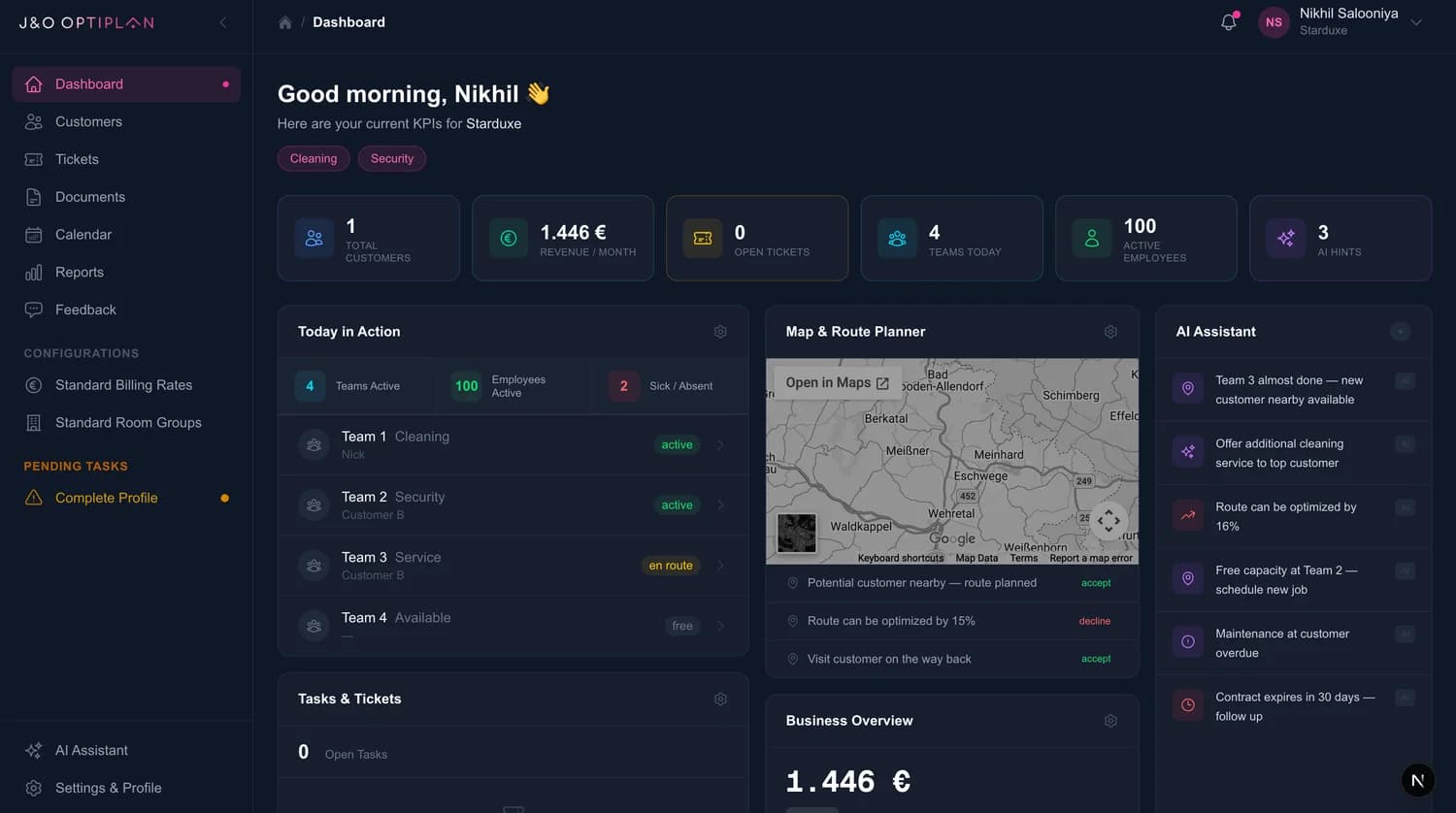
Separate portals for separate people.
Employees, customers, and internal staff each get an interface scoped to what they need to see and do, rather than one screen trying to serve every role.

Operations software
A clearer view of the work ahead.
Operations software for the people, sites, and planning behind facility services.
01 / THE CONTEXT
A facility services business runs on people, sites, and schedules that all change at once — a site added, staff reassigned, a billing rate that differs by contract. OptiPlan is the operations product built for a German-market client to hold that picture in one place instead of several spreadsheets that disagree with each other.
02 / THE FOCUS
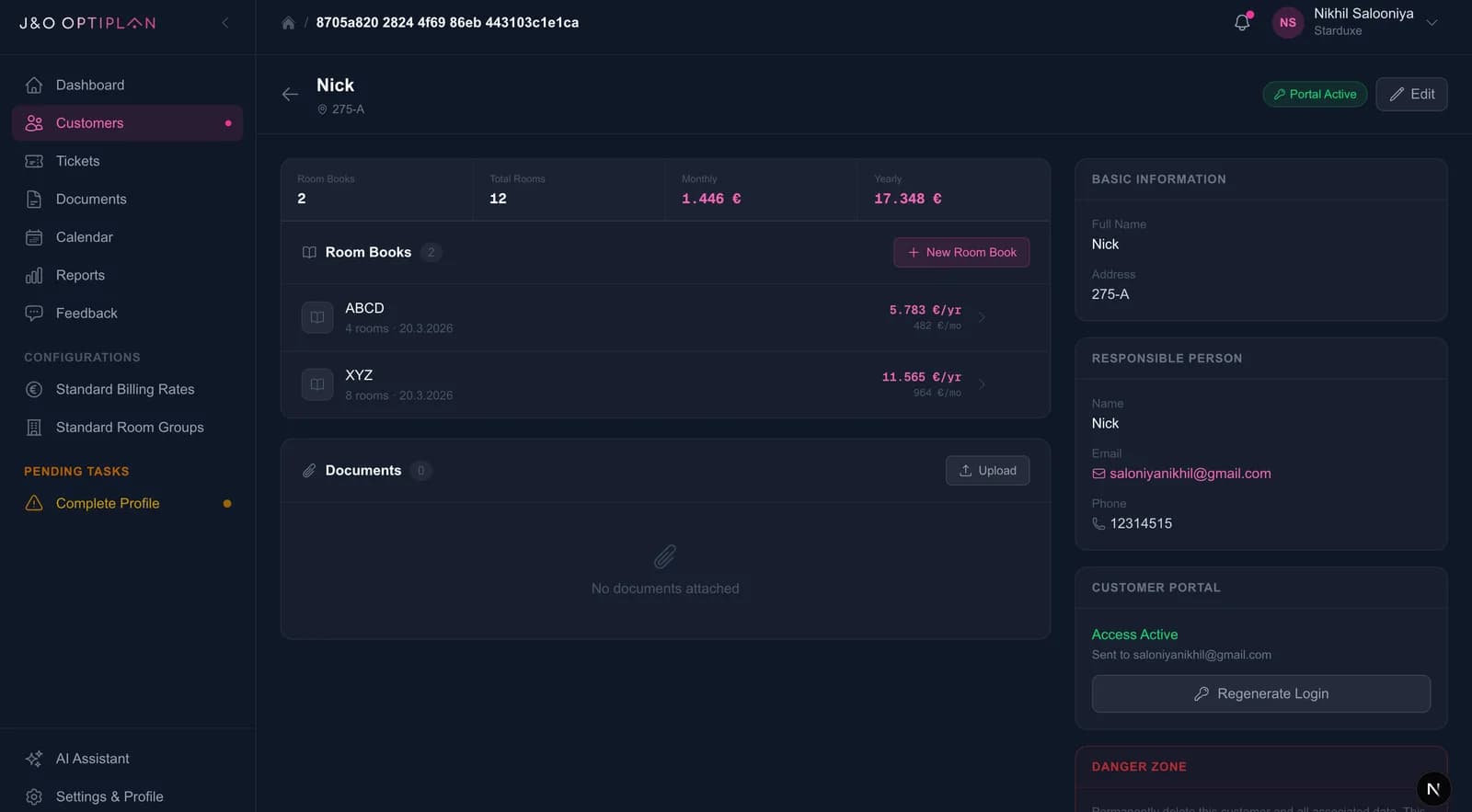
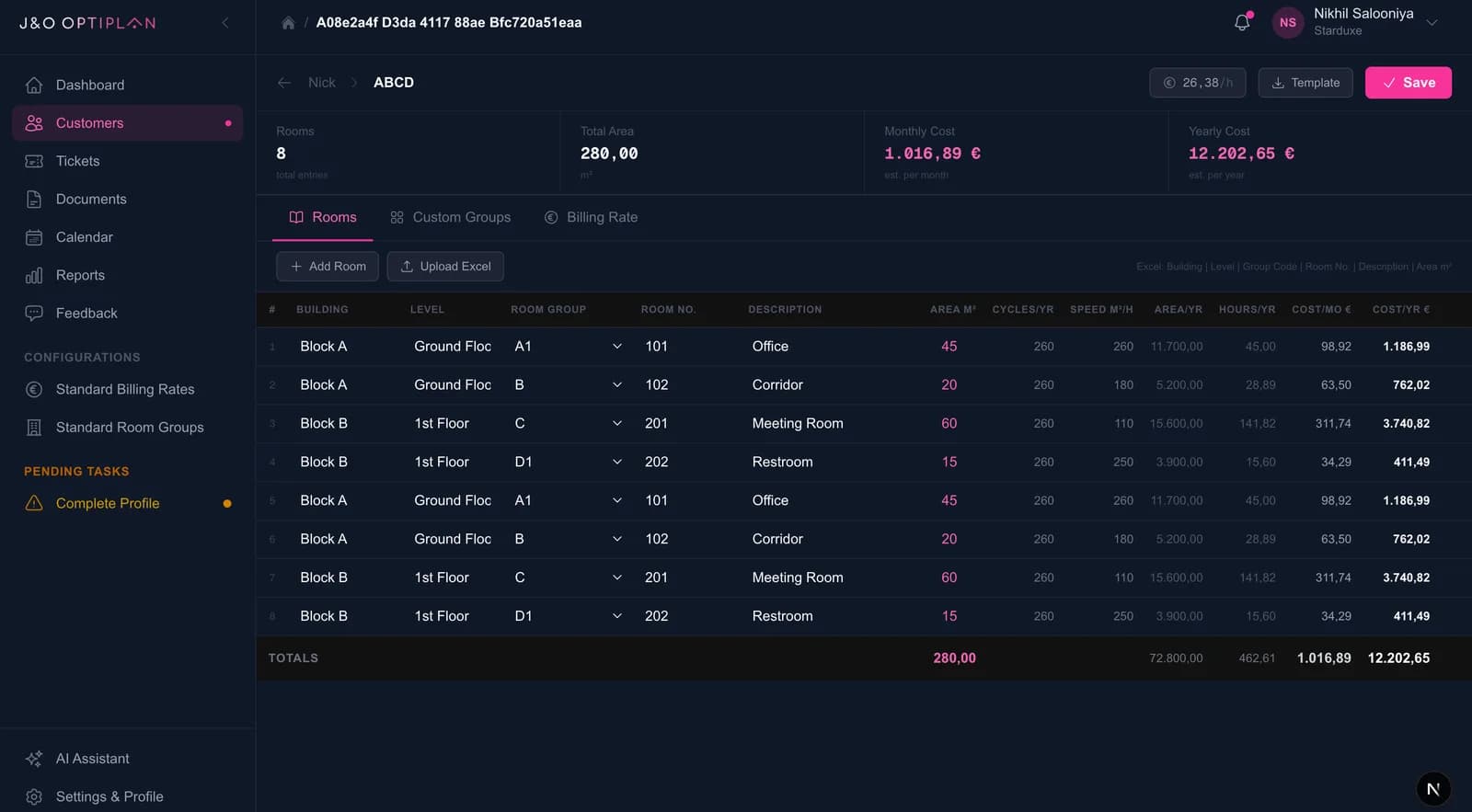
The platform now covers personnel and site management, room groups, billing rates, a ticketing system for day-to-day issues, a shared calendar, and separate portals for the client’s own customers and employees — with an AI-assisted layer added where it genuinely reduces manual work, not as decoration.
The priorities that shape the product and the experience.
Employees, customers, and internal staff each get an interface scoped to what they need to see and do, rather than one screen trying to serve every role.
Rates, sites, and room groups are modelled so a contract’s actual terms drive billing, instead of a rate being edited by hand each time something changes.
Each stage ships as something usable on its own — Stage 3 is signed and in development — rather than one long release with nothing working until the end.
The decisions that shaped how this was actually put together.
Facility services operations resist generic software because the details differ per contract: which sites are covered, how staff are assigned, what rate applies to which room group, what counts as billable. OptiPlan models those relationships directly rather than approximating them, which is the difference between software that reduces admin work and software that becomes another system someone maintains by hand alongside the spreadsheets.
Internal staff, the client's own customers, and employees in the field need different things from the same underlying data. Building one screen to serve all three produces an interface that's cluttered for everyone and appropriate for no one. Separate portals, each scoped to what that audience actually does, keeps permissions comprehensible and the interfaces usable.
The work is structured so each stage delivers something the client can use on its own rather than a long build with nothing working until the end. Stage 3 is signed and in development. For operations software replacing existing manual processes, this matters commercially as well as technically — the client sees value and can course-correct while the scope is still adjustable.
Views from the product.
Tell us about the challenge you’re working on. We’ll help find a useful place to start.
GOOD THINGS START WITH A CONVERSATION.
YOUR NEXT CHAPTER STARTS HEREAn ambitious idea. A fresh challenge.
Something you can’t stop thinking about. We’re listening.